
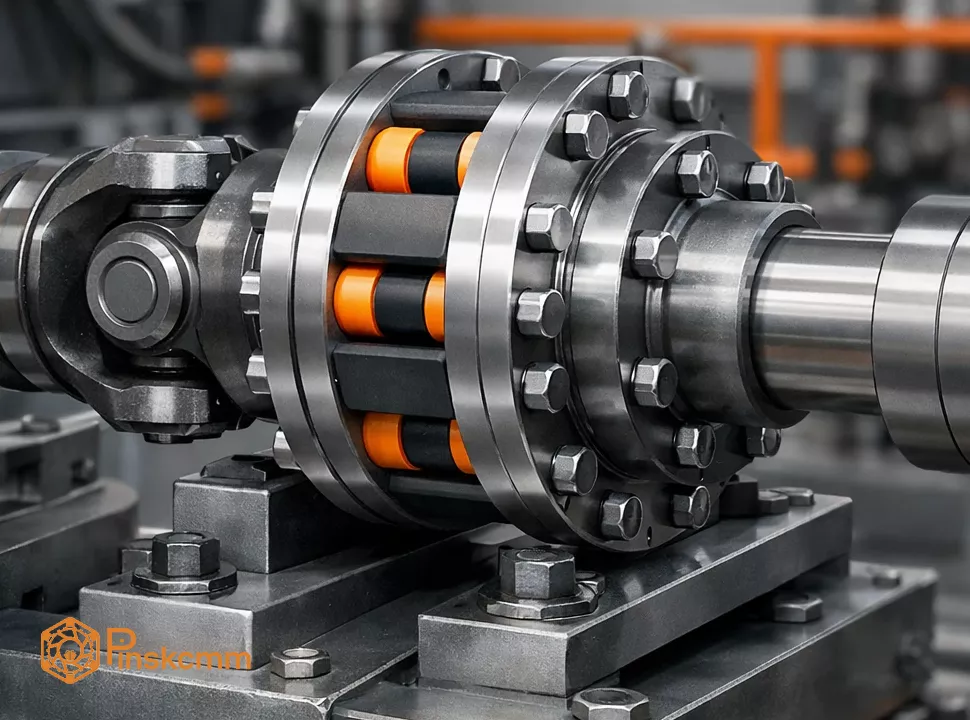
Cardan shafts, commonly known as universal joint shafts, are widely used in driveline systems where angular displacement and non‑linear alignment are unavoidable. While effective in transmitting torque across misaligned axes, cardan shafts introduce torsional irregularities and localized bearing loads that must be managed by appropriate coupling solutions.
Elastic couplings serve a critical role in mitigating these effects by decoupling misalignment, damping torsional vibrations, and protecting downstream components from fatigue accumulation.
Overview of the VULKAN VULKARDAN P Coupling
The VULKAN VULKARDAN P coupling is specifically engineered for cardan shaft applications where elastic behavior and compact integration are required. Rather than functioning as a rigid torque connector, this coupling is designed to act as a torsional buffer within the driveline.
Its architecture is optimized to address three dominant challenges in cardan‑based systems:
- Angular and axial misalignment
- Torsional vibration and resonance
- Shock loads caused by transient torque events
Design Architecture and Functional Elements
Highly Elastic Elastomeric Elements
At the core of the VULKARDAN P design are highly elastic elastomeric elements, typically formulated from industrial‑grade rubber compounds. These elements are positioned to:
- Accommodate angular and axial misalignment
- Reduce stress concentrations in U‑joint bearings
- Smooth torque transmission under variable load conditions
The elastic behavior allows controlled deformation without permanent set, supporting long‑term operational stability.
Compact and Lightweight Configuration
The coupling’s compact form factor enables installation in space‑constrained drivelines. This is particularly relevant in mobile equipment, marine propulsion systems, and industrial installations where axial space and component mass are limited.
Vibration Damping and Dynamic Behavior
Elastic couplings such as the VULKARDAN P provide inherent torsional damping. By absorbing vibrational energy within the elastomeric medium, the coupling limits transmission of high‑frequency oscillations through the driveline.
From a system‑level perspective, this damping:
- Reduces audible noise
- Lowers cyclic stress on shafts and bearings
- Mitigates vibration‑induced fatigue failures
These characteristics are especially valuable in cardan shafts, where speed fluctuations are structurally unavoidable.
Misalignment Compensation and Bearing Load Reduction
Misalignment in cardan systems directly increases bearing loads and accelerates wear. The elastic elements of the VULKARDAN P coupling act as a compliance layer, redistributing forces more evenly across U‑joint bearings.
This function leads to:
- Extended bearing service life
- Reduced maintenance frequency
- Improved operational predictability under variable alignment conditions
Shock Load Absorption
Sudden changes in torque—such as startup transients, load reversals, or emergency stops—generate shock loads that propagate through the driveline. The elastomeric structure of the coupling absorbs and dissipates this energy, reducing peak stresses transmitted to adjacent components.
Connection Configurations for Cardan Shafts
The VULKARDAN P coupling is available in two primary connection concepts, each serving different installation strategies.
Internal Connection Configuration
In the internal configuration, both the cardan shaft and the coupling are mounted inward toward the shaft centerline. This allows for separate installation of the coupling and shaft components and is often preferred where modular assembly is required.
External Connection Configuration
In the external configuration, the cardan shaft is connected to the outer coupling flange, creating a pre‑assembled unit. This approach simplifies installation and reduces alignment effort during commissioning.
Engineering Context and Industry Usage
Elastic couplings designed for cardan shafts are commonly applied across marine propulsion, energy generation, heavy machinery, and industrial drive systems. Technical literature and application analyses published by coupling manufacturers and industrial system suppliers—including Seawide—emphasize the importance of matching elastomer stiffness, damping characteristics, and misalignment capacity to the overall driveline dynamics rather than selecting couplings solely based on torque ratings.
The VULKAN VULKARDAN P coupling represents a specialized solution within elastic driveline technology, addressing the unique dynamic challenges associated with cardan shafts. Through controlled elasticity, vibration damping, and compact integration, it contributes to improved reliability and performance of power transmission systems operating under misalignment and variable loading conditions.
