
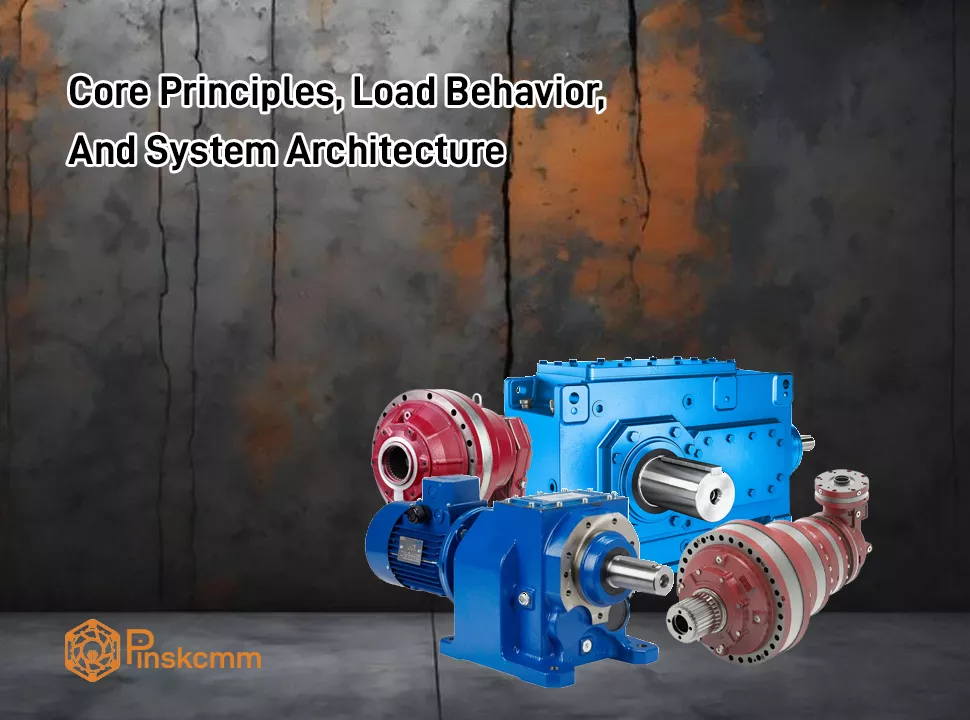
Power transmission systems form the mechanical backbone of industrial machinery, converting rotational motion into usable torque and speed for a wide range of applications. At the heart of these systems lie gears and mechanical transmission components, whose correct selection and integration directly influence efficiency, durability, vibration behavior, and overall system reliability. Understanding the fundamental principles behind gear and transmission systems is essential for engineers involved in design, procurement, installation, and maintenance.
1. Purpose of Gear and Transmission Systems
The primary function of any gear or transmission system is to modify motion. This modification typically involves:
- Changing rotational speed
- Multiplying or reducing torque
- Redirecting power flow
- Synchronizing motion between components
Electric motors, turbines, and engines often operate at speeds unsuitable for direct use. Transmission systems adapt this input energy to match the operational requirements of industrial processes such as conveying, lifting,
mixing, rolling, or propulsion.
2. Basic Gear Types and Their Functional Roles
Different gear geometries serve different mechanical objectives. The most widely used types include:
Spur Gears
Spur gears transmit power between parallel shafts with straight teeth. They are efficient and easy to manufacture but generate higher noise at elevated speeds due to abrupt tooth engagement.
Helical Gears
Helical gears employ angled teeth, allowing gradual engagement. This results in smoother operation, higher load capacity, and reduced noise, at the cost of axial thrust that must be managed by bearings.
Bevel Gears
Used to transmit power between intersecting shafts, commonly at 90 degrees. Bevel gears are essential in applications where direction changes are required.
Planetary (Epicyclic) Gear Sets
Planetary systems distribute load across multiple gear contacts, offering high torque density, compact design, and coaxial input-output alignment. These characteristics make them ideal for heavy-duty and space-constrained applications.
Each gear type introduces different stress patterns, efficiency levels, and sensitivity to misalignment, which must be considered during system design.
3. Torque, Speed, and Power Relationships
A fundamental principle of transmission systems is the relationship between torque, speed, and power:
Power is conserved across an ideal transmission:
P=T×ω P = T \times \omega Where:
- T T is torque
- ω \omega is angular velocity
When speed is reduced via gearing, torque increases proportionally (minus losses). This trade-off defines the mechanical advantage of gear systems and directly impacts shaft sizing, bearing selection, and housing rigidity.
Understanding nominal torque, peak torque, and shock load conditions is critical. Many industrial failures occur not due to steady-state loading but transient overloads during start-up, braking, or process disturbances.
4. Load Distribution and Tooth Contact Mechanics
Gear teeth do not carry load uniformly. Load distribution depends on:
- Tooth profile accuracy
- Shaft alignment
- Housing stiffness
- Manufacturing tolerances
Even minor misalignments can lead to edge loading, elevated contact stress, and premature pitting or scuffing. Modern gear design relies on micro-geometry modifications such as lead crowning and profile relief to compensate for elastic deformation under load.
Surface durability is commonly evaluated using standards such as ISO and AGMA, which define contact stress limits and bending fatigue criteria.
5. Materials and Heat Treatment Fundamentals
Gear performance is strongly influenced by material choice and heat treatment. Common gear steels include alloyed grades designed for case hardening. Typical characteristics include:
- Hard wear-resistant surfaces (58–62 HRC)
- Tough, ductile cores for shock resistance
Heat treatment methods such as carburizing, nitriding, or induction hardening increase fatigue life and resistance to micro-pitting. However, improper heat treatment can introduce distortion, residual stress, or surface brittleness.
Material selection must balance strength, manufacturability, and cost while matching the application’s load spectrum.
6. Efficiency and Loss Mechanisms
Transmission efficiency is affected by:
- Sliding friction between gear teeth
- Bearing losses
- Seal friction
- Lubrication regime
Helical and planetary systems typically exhibit slightly lower efficiency than spur gears due to increased sliding contact, but they compensate through smoother torque transmission and reduced dynamic loads.
In high-power or continuous-duty systems, even small efficiency losses can result in significant heat generation, making thermal management a critical design factor.
7. Role of Lubrication in Transmission Fundamentals
Lubrication is essential for:
- Reducing friction
- Preventing wear
- Removing heat
- Protecting against corrosion
Gear lubrication regimes range from boundary and mixed lubrication at low speeds to full elastohydrodynamic lubrication (EHL) in high-speed applications. Incorrect lubricant viscosity or contamination is among the most common root causes of transmission failure.
Oil selection must consider operating temperature, load, speed, and environmental conditions.
8. Vibration, Noise, and Dynamic Behavior
Transmission systems are dynamic by nature. Gear mesh frequency, resonance, and torsional vibration can amplify noise and fatigue loads. Key contributors include:
- Tooth profile errors
- Backlash variation
- Shaft torsional stiffness
- Coupling selection
Controlling vibration at the transmission level improves system lifespan and reduces secondary failures in bearings, seals, and adjacent machinery.
9. Integration Within Complete Drive Systems
Gears never operate in isolation. Their performance depends on interaction with:
- Motors or prime movers
- Couplings
- Bearings
- Foundations and alignment
A system-level perspective is essential. Overspecifying gear strength while neglecting coupling flexibility or alignment capability often results in unexpected failures.
10. Why Fundamentals Still Matter
Despite advances in simulation and manufacturing, most transmission failures trace back to violations of fundamental principles: improper load assumptions, misalignment, inadequate lubrication, or incorrect material selection.
Engineers who understand the fundamentals of gear and power transmission systems are better equipped to design reliable solutions, diagnose failures, and optimize performance across the full lifecycle of industrial equipment.
