
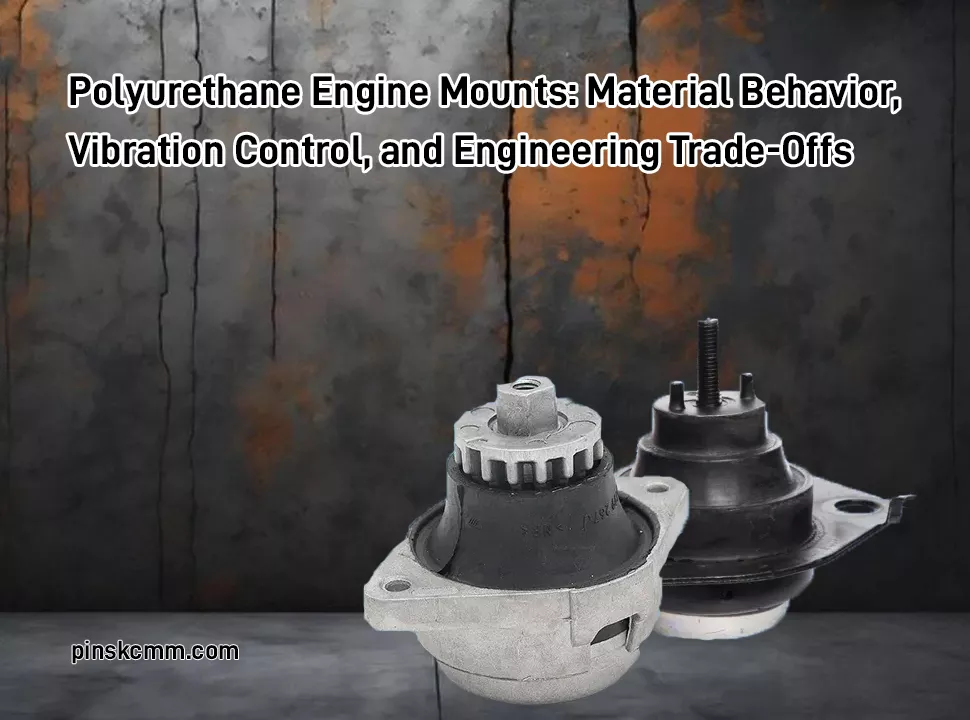
Polyurethane engine mounts play a critical role in vibration isolation and structural stability within automotive and industrial machinery. Their function extends beyond simple engine support, influencing noise attenuation, fatigue life of connected components, and overall system reliability. Compared to traditional elastomeric solutions, polyurethane offers a distinct balance between stiffness, durability, and environmental resistance.
Fundamental Role of Engine Mounting Systems
Engine mounts are designed to mechanically support power units while isolating dynamic forces generated by combustion, rotation, and transient loading. Effective mounts must simultaneously manage:
- Static engine weight
- Dynamic torque reaction
- High‑frequency vibration
- Misalignment tolerance
Failure in any of these areas can lead to accelerated wear, noise amplification, or structural damage to adjacent assemblies.
Polyurethane as an Engineering Material
Polyurethane (PU) is a class of elastomeric polymers formed through the reaction of polyols and diisocyanates. Unlike conventional rubber compounds, polyurethane can be engineered across a wide hardness spectrum—commonly defined by Shore A values—allowing precise tuning of stiffness and damping characteristics.
From an engineering perspective, this tunability enables targeted performance optimization rather than one‑size‑fits‑all damping behavior.
Mechanical and Physical Properties Relevant to Engine Mounts
Polyurethane exhibits a combination of properties that make it suitable for demanding mounting applications:
- High resistance to abrasion and tearing
- Superior fatigue life under cyclic loading
- Stable mechanical behavior over a wide temperature range
- Resistance to oils, fuels, and industrial chemicals
These properties contribute to consistent vibration control over extended operational lifecycles, particularly in environments where conventional rubber materials degrade prematurely.
Vibration Control and Damping Behavior
Unlike soft rubber mounts that prioritize comfort, polyurethane mounts tend to operate in a mid‑to‑high stiffness range. This allows them to:
- Limit excessive engine movement under torque
- Maintain driveline alignment
- Reduce long‑term deformation (creep)
While higher stiffness may transmit slightly more vibration in some configurations, careful selection of material hardness can balance isolation performance with mechanical stability—especially in systems exposed to dynamic or shock loading.
Durability and Environmental Resistance
One of the primary advantages of polyurethane engine mounts is their resistance to environmental degradation. Polyurethane maintains structural integrity when exposed to:
- Elevated temperatures
- Hydrocarbon‑based lubricants
- Fuel vapors
- Moisture and ultraviolet radiation
This resistance makes polyurethane particularly suitable for industrial machinery, off‑road vehicles, and power units operating in harsh or contaminated environments.
Engineering Trade‑Offs in Polyurethane Mount Design
Although polyurethane offers enhanced durability, it introduces design considerations that must be evaluated:
- Increased stiffness may elevate transmitted vibration
- Improper hardness selection can reduce isolation effectiveness
- Mount geometry becomes more critical in dynamic load control
These trade‑offs highlight the importance of system‑level analysis when selecting polyurethane mounts rather than relying solely on material strength metrics.
Metals and Supporting Materials in Engine Mount Assemblies
Structural Metals in Mounting Systems
While elastomeric materials control vibration, metallic components ensure load‑bearing integrity.
Steel
Steel remains the most widely used structural metal in engine mounts due to its strength and fatigue resistance. Carbon steel and stainless steel variants are chosen based on load demands and corrosion exposure.
Aluminum
Aluminum is frequently applied where weight reduction is a priority. Its corrosion resistance and favorable strength‑to‑weight ratio make it suitable for passenger vehicles and lightweight machinery.
Cast Iron
In heavy‑duty applications, cast iron offers high compressive strength and inherent vibration damping, particularly in large industrial power units.
Specialty Alloys
For specialized environments, materials such as titanium may be used to combine strength, corrosion resistance, and thermal stability, albeit at significantly higher cost.
Elastomers and Composite Layers
Engine mounts typically combine metals with elastomeric materials to achieve functional separation between structure and vibration.
- Rubber and synthetic elastomers provide soft vibration isolation
- Polyurethane offers higher stiffness and extended service life
- Composite layers may be used to reduce mass or tune damping response
The interaction between metal stiffness and elastomeric behavior defines the overall performance envelope of the mounting system.
Material Selection Considerations
Selecting materials for engine mounts requires simultaneous evaluation of:
- Load capacity and torque reaction
- Vibration frequency range
- Environmental exposure
- Weight limitations
- Lifecycle and maintenance strategy
In many modern designs, polyurethane is selected where durability and dimensional stability take precedence over maximum vibration attenuation.
Emerging Developments in Engine Mount Materials
Ongoing research in materials science continues to influence engine mount design, particularly in industrial environments where vibration control and durability must coexist. Industry documentation and application notes published by manufacturers and system suppliers—including Seawide—indicate a growing emphasis on material behavior analysis, lifecycle predictability, and system‑level vibration management rather than component‑level isolation alone.
Polyurethane engine mounts occupy a distinct position within vibration isolation engineering, offering a balance of durability, stiffness control, and environmental resilience. When evaluated within a complete mechanical system—rather than as isolated components—they provide engineers with a versatile solution for managing dynamic loads across automotive and industrial applications. As material engineering advances, the role of polyurethane in mounting systems is expected to expand further through improved customization and performance predictability.
