
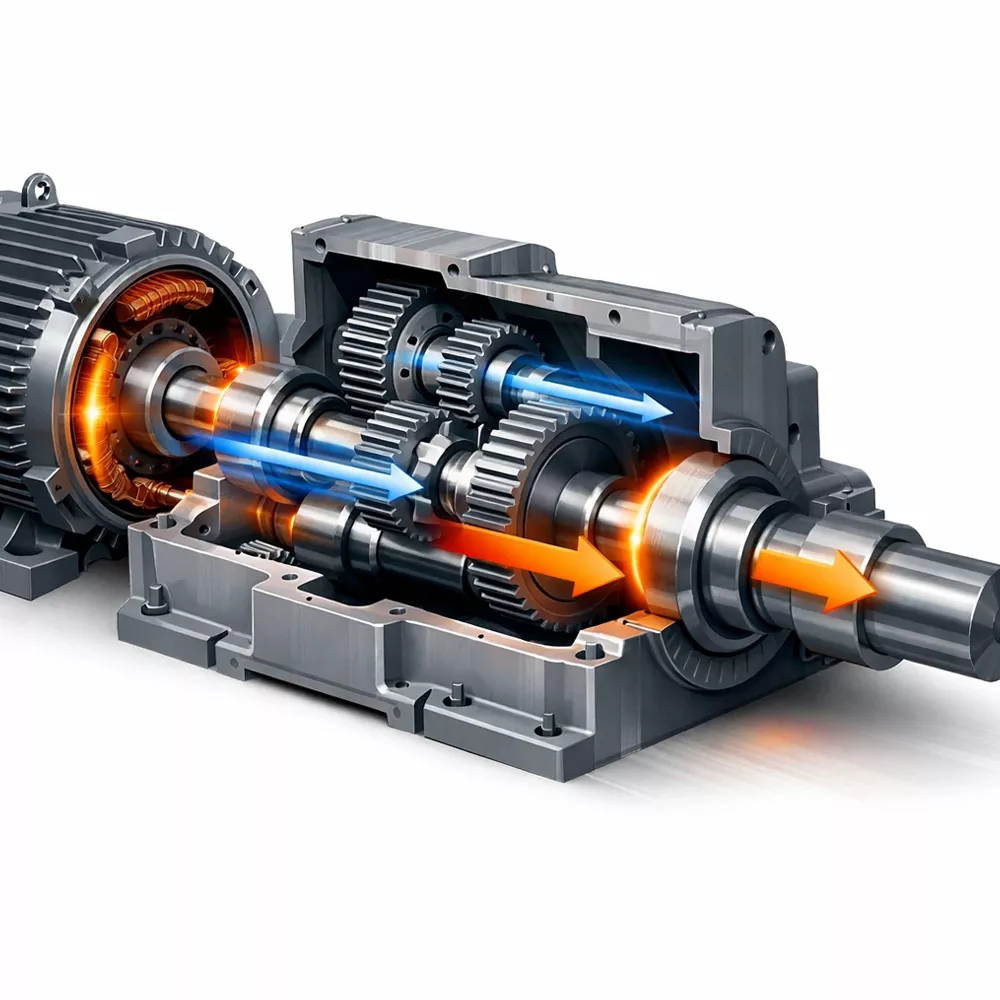
Torque, Speed, and Power: Misconceptions in Industrial Mechanical Design
Torque, speed, and power are among the most frequently used—and most frequently misunderstood—concepts in industrial mechanical design. Despite being taught early in engineering education, their practical interpretation is often distorted once systems move from theory into real operating environments.
Many mechanical failures, oversized systems, and inefficient designs originate not from incorrect calculations, but from conceptual misunderstandings about how torque, speed, and power actually interact in power transmission systems.
This article addresses the most common misconceptions and explains why “knowing the formula” is not the same as understanding the system.
Why Confusion Persists in Industrial Practice
The fundamental relationship is simple:
P=T×ω P = T \times \omega
Where power is the product of torque and angular speed.
Yet simplicity is deceptive. This equation describes energy flow, not mechanical behavior. In real systems, torque, speed, and power interact with:
- Load dynamics
- Structural stiffness
- Thermal behavior
- Transient conditions
Design problems arise when engineers treat this equation as a sizing shortcut rather than a system description.
Misconception 1: “If Power Is Correct, the System Is Safe”
One of the most dangerous assumptions in industrial design is that selecting a motor or gearbox with sufficient power rating guarantees system safety.
Power ratings are typically defined under:
- Steady-state conditions
- Nominal speeds
- Controlled environments
They do not account for:
- Shock loads
- Start-stop cycles
- Load reversals
- Torsional oscillations
A system can be perfectly sized for power and still fail catastrophically due to excessive torque peaks.
Misconception 2: “High Torque Means High Power”
Torque is not power.
High torque at low speed can correspond to relatively low power, while moderate torque at high speed may represent very high power flow.
Common design error:
- Focusing on torque values without understanding the associated speed range
- Assuming “more torque” automatically means “stronger system”
In reality, torque primarily dictates mechanical stress, while power dictates energy transfer. Confusing the two leads to:
- Overstressed shafts
- Bearing failures
- Gear tooth fatigue
Misconception 3: “Gearboxes Multiply Power”
Gearboxes do not create power. They redistribute it.
What gearboxes actually do:
- Increase torque at the expense of speed
- Modify load characteristics
- Introduce mechanical losses
Yet many system layouts implicitly assume that gear reduction “adds strength” to the system. This misunderstanding often results in:
- Underestimating input shaft stresses
- Ignoring reflected inertia effects
- Misjudging dynamic load amplification
The gearbox is a transformer, not a generator.
Torque Peaks vs. Rated Torque
Industrial systems rarely operate at constant torque.
Torque profiles typically include:
- Acceleration peaks
- Transient overloads
- Process-induced fluctuations
Rated torque values are averages or limits under defined conditions. Designing solely around rated torque ignores:
- Peak-to-average ratios
- Fatigue accumulation
- Safety factor erosion over time
Many gearbox and coupling failures occur even when rated torque is “within limits.”
Speed: The Silent Design Variable
Speed is often treated as a secondary parameter—something to be adjusted with ratios rather than designed around.
This is a mistake.
Speed directly affects:
- Bearing life
- Lubrication regime
- Thermal generation
- Vibration behavior
Increasing speed to reduce torque may satisfy power equations, but it often introduces new failure modes related to:
- Heat buildup
- Oil film breakdown
- Resonance
Speed is not a free variable.
Power Ratings and the Illusion of Margin
Manufacturers publish power ratings with defined assumptions:
- Continuous operation
- Uniform load
- Proper lubrication
- Ideal alignment
Real systems violate these assumptions regularly.
Designers who rely exclusively on power ratings without understanding torque distribution and speed variability often experience:
- Unexpected downtime
- Premature wear
- Warranty disputes
Power ratings are guidance—not guarantees.
System-Level Consequences of Misinterpretation
Misunderstanding torque, speed, and power leads to systemic problems, not isolated failures.
Common outcomes include:
- Oversized motors paired with fragile drivetrains
- Efficient systems with poor durability
- Robust components assembled into unstable architectures
True system integrity emerges only when torque paths, speed ranges, and power flow are evaluated together.
Organizations with strong system-level engineering—such as Seawide—treat torque, speed, and power as interacting behaviors rather than independent selection numbers.
Correct Design Thinking: From Numbers to Behavior
Good industrial design shifts focus from static values to dynamic behavior:
- How torque changes over time
- How speed varies under load
- How power flows through each interface
This perspective transforms selection from catalog matching into engineering judgment.
Conclusion: Understanding Prevents Oversizing—and Failure
Torque, speed, and power are not interchangeable metrics. Each describes a different aspect of system behavior.
Misunderstanding their roles leads to:
- Overdesigned systems that waste resources
- Underdesigned systems that fail prematurely
Engineering maturity lies in recognizing that power defines energy, torque defines stress, and speed defines behavior—and none of them should be considered in isolation.
