
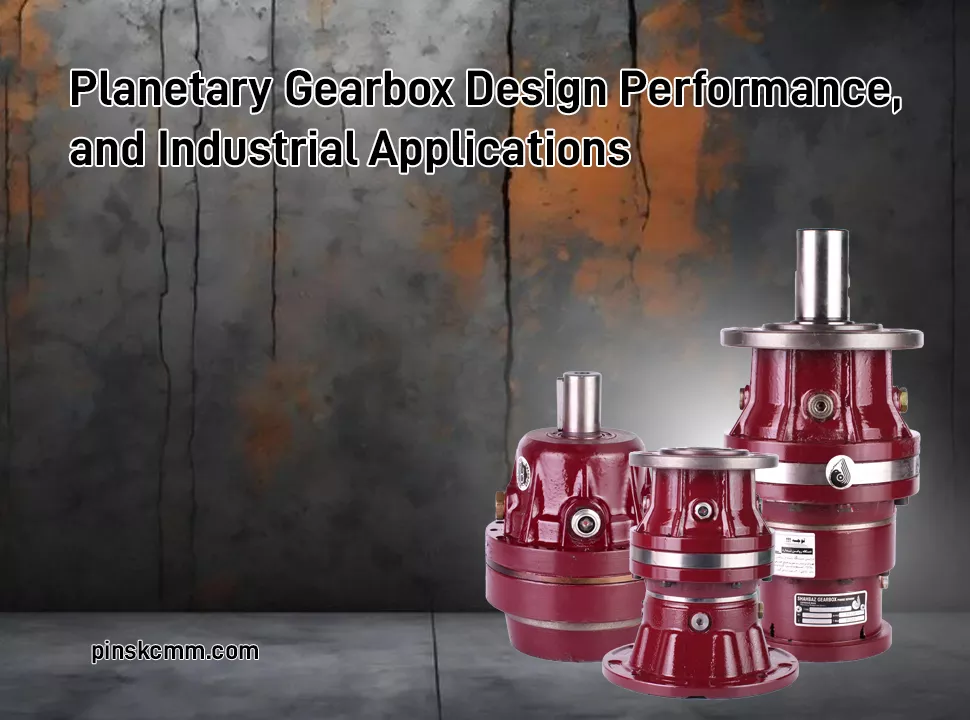
Planetary Gearbox Design and Performance Principles
Planetary gearbox design and performance play a critical role in modern industrial motion systems, where high torque density, compact dimensions, and reliability under continuous load are essential. Across manufacturing, energy, and heavy process industries, planetary gear configurations have become a foundational solution for transmitting rotational power while maintaining mechanical stability and efficiency.
Unlike conventional parallel‑shaft gear arrangements, planetary systems integrate multiple load paths into a coaxial layout, allowing them to manage extreme torque demands within constrained installation spaces.
Mechanical Architecture of Planetary Gear Systems
A planetary gearbox consists of three interconnected mechanical elements that together enable high power density and controlled motion transmission.
The sun gear functions as the primary input component, transmitting rotational energy into the system. Surrounding it are multiple planet gears, which rotate around the sun gear while simultaneously meshing with the ring gear, an internally toothed outer component. These planet gears are mounted on a planet carrier, which often serves as the output element depending on the drivetrain configuration.
The defining strength of this architecture lies in its multi‑path torque distribution, where transmitted loads are divided across several gear meshes rather than concentrated on a single engagement point. This structural principle enhances fatigue resistance and reduces localized stress accumulation.
Load Sharing and Efficiency Characteristics
One of the most significant performance attributes of planetary gearboxes is their ability to distribute load evenly across multiple gear teeth. This load‑sharing mechanism improves torque capacity without a proportional increase in gearbox size.
Under steady operating conditions, efficiency levels commonly range between 95 % and 98 % per stage, depending on gear geometry, bearing selection, and lubrication design. In multi‑stage planetary systems, overall efficiency is a function of cumulative stage losses:
η_total = η₁ × η₂ × η₃
With modern manufacturing tolerances, planetary units maintain favorable efficiency even in high‑ratio configurations, making them suitable for applications where energy losses directly affect operational cost.
Material Selection and Manufacturing Precision
The long‑term performance of planetary gear systems is closely linked to material quality and manufacturing precision. Load‑bearing gears are typically produced from carburized and ground alloy steels such as 20CrMnTi or 18CrNiMo7‑6, chosen for their balance of surface hardness and core toughness.
Precision heat treatment processes create a hardened wear‑resistant surface layer while preserving internal ductility. Gear finishing methods, including profile grinding, reduce surface roughness and transmission error, contributing to lower vibration, reduced noise, and extended service life.
Structural elements such as housings and planet carriers must resist deformation under high reaction forces. Ductile iron and forged steel are commonly employed to ensure stiffness, alignment stability, and resistance to installation‑induced stresses.
Backlash Control and Dynamic Stability
In applications involving frequent start‑stop cycles, reversing motion, or speed synchronization, backlash control becomes a primary consideration. Excessive angular clearance introduces positioning delay and shock loading, which can compromise mechanical integrity over time.
Planetary gearboxes mitigate these effects through symmetrical gear engagement and precision bearing support. Low‑backlash configurations are commonly applied in servo‑driven systems, where positioning accuracy and repeatability directly influence machine output quality.
Maintaining backlash stability throughout the service life of the gearbox depends on bearing preload accuracy, lubrication integrity, and housing rigidity.
Comparison with Alternative Gearbox Configurations
From a system‑level perspective, planetary gearboxes tend to outperform alternative designs where compactness and torque density are prioritized. Parallel‑shaft helical gearboxes, while efficient and cost‑effective, generally require more installation space to achieve equivalent torque ratings. Worm gear systems, despite their compact form, suffer from lower efficiency due to sliding contact and are less suitable for continuous heavy‑duty operation.
Planetary systems represent a balanced solution where high efficiency, structural symmetry, and space optimization must coexist.
Industrial Application Landscape
Planetary gearboxes are applied across a wide range of industries where mechanical reliability is essential.
In steel and metallurgical processing, they are integrated into rolling mills, coilers, and material handling systems that operate under cyclical loads and elevated temperatures.
In cement and aggregate production, planetary drives handle continuous torque demands in kilns, grinding mills, and heavy conveyors.
Mining and earth‑moving equipment relies on planetary gear systems to absorb shock loads while delivering high breakout torque in compact assemblies.
In energy and process industries, planetary reducers support mixers, extruders, and reactor drives where controlled low‑speed torque is required.
Modern wind turbine drivetrains employ multi‑stage planetary configurations to convert low rotor speeds into generator‑compatible rotational input.
Manufacturers such as Seawide, alongside other integrated drivetrain suppliers, reference planetary architectures in applications where high torque density and structural reliability are critical design priorities.
Integration and System‑Level Considerations
Selecting a planetary gearbox extends beyond torque and ratio calculations. Engineers must account for duty cycle intensity, thermal behavior, environmental exposure, and interface compatibility with upstream and downstream components.
Mounting orientation influences load paths and bearing stress, while ingress protection ratings determine suitability for dusty or humid environments. For safety‑critical sectors, adherence to standards such as ISO, AGMA, ATEX, or marine classifications may be required.
System integration quality ultimately determines whether the theoretical performance advantages of planetary design are realized in practice.
Engineering Perspective on Performance Optimization
From a drivetrain engineering standpoint, planetary gearbox performance is the result of coordinated mechanical design rather than isolated specifications. Efficiency, durability, and precision are interdependent outcomes shaped by gear geometry, material behavior, and housing stiffness.
As industrial systems evolve toward higher power density and tighter spatial constraints, planetary gear configurations continue to provide a scalable solution capable of adapting to increasingly demanding operational requirements.
Editorial Close (No CTA)
Ongoing developments in materials engineering, digital monitoring, and manufacturing precision continue to refine planetary gearbox performance across industrial motion systems. As these technologies mature, planetary architectures are expected to remain a central component of high‑duty power transmission design.
