
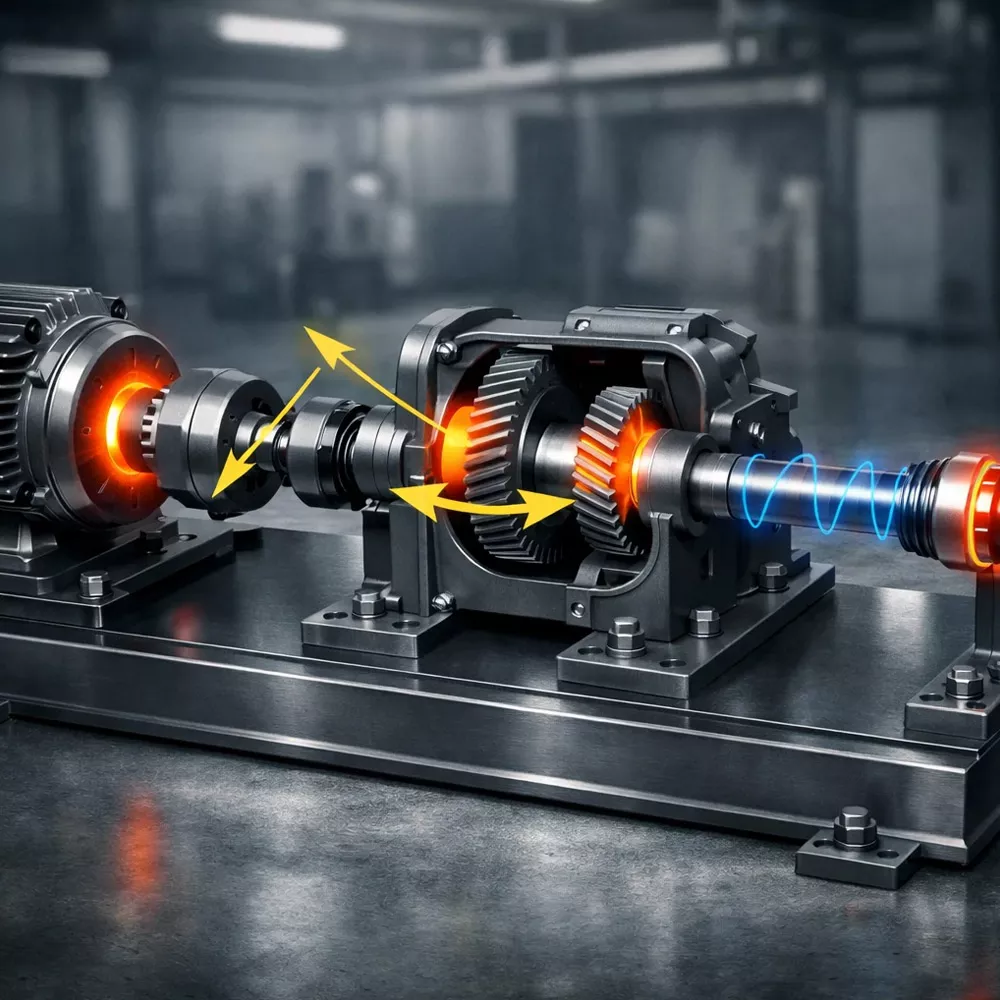
Mechanical power transmission systems form the backbone of industrial machinery. From conveyors and mixers to compressors and processing lines, their reliability directly determines uptime, product quality, and operational cost. Yet despite decades of engineering development, failures in mechanical power transmission remain widespread—and often repetitive.
The primary reason is not insufficient component quality, but a persistent misunderstanding of how failures actually originate. Most industrial failures are not isolated component defects; they are system‑level outcomes driven by load interactions, structural behavior, thermal dynamics, and operational assumptions.
This article examines the fundamental failure modes of mechanical power transmission systems from an engineering perspective, focusing on why failures occur rather than merely what fails.
Failure Modes vs. Failure Mechanisms
A critical distinction in failure analysis is the difference between failure mode and failure mechanism.
- A failure mode describes the observable outcome: gear tooth fracture, bearing overheating, abnormal noise, lubricant degradation.
- A failure mechanism explains the physical process that caused it: excessive contact stress, boundary lubrication breakdown, cyclic fatigue, or misalignment‑induced load concentration.
Many corrective actions fail because they address the mode instead of the mechanism. Replacing a gearbox with a higher nominal torque rating does not prevent failure if the underlying mechanism—such as transient overload or thermal instability—remains unchanged.
Load Definition Errors: The Root of Many Failures
Incorrect load definition is arguably the most common origin of failure in power transmission systems. Design loads are frequently based on steady‑state torque values, while real systems experience:
- Start‑up torque spikes
- Shock loads from process disturbances
- Load reversals and cyclic duty patterns
- Torque amplification due to torsional stiffness mismatches
When these effects are ignored, components operate closer to fatigue limits than expected. The system may function for months or even years before failure, creating the illusion of adequate design—until accumulated damage reaches a critical threshold.
Load is not a single number; it is a spectrum of mechanical events over time.
Misalignment as a Force Multiplier
Misalignment is rarely catastrophic by itself. Its danger lies in how it redistributes forces within the system.
Even small angular or parallel misalignments can:
- Increase bearing reaction forces
- Concentrate gear tooth contact near edges
- Induce additional bending moments in shafts
- Accelerate lubricant film breakdown
Crucially, misalignment often originates outside the gearbox. Foundation settling, thermal growth of connected equipment, and assembly tolerances all contribute. Treating misalignment as a gearbox defect overlooks the system conditions that created it.
Thermal Failure: When Energy Has Nowhere to Go
All mechanical systems dissipate energy as heat. Failure occurs when heat generation exceeds the system’s ability to remove it.
Common contributors include:
- High internal losses from sliding contact
- Excessive preload or bearing friction
- Elevated ambient temperatures
- Inadequate housing heat transfer
Thermal failure is often misdiagnosed as a lubrication problem because lubricant degradation is the visible symptom. In reality, lubricant breakdown is usually the result of thermal imbalance, not the cause.
Once temperature rises beyond a critical point, viscosity drops, film thickness collapses, and surface damage accelerates rapidly.
Lubrication Breakdown Is Rarely the Root Cause
Lubrication is frequently blamed because it is accessible and measurable. However, most lubrication failures stem from mechanical conditions that exceed lubricant capability.
Typical contributors include:
- Excessive contact stress
- Misalignment‑induced edge loading
- Contamination from seals or assembly practices
- Thermal instability within the housing
Changing lubricant type or shortening maintenance intervals may delay failure, but without correcting mechanical drivers, the system remains vulnerable.
Lubrication does not compensate for incorrect load paths.
Fatigue: The Silent Accumulator
Unlike overload failures, fatigue progresses invisibly. Surface distress often begins at the micro‑scale:
- Micro‑pitting develops before macro‑pitting
- Subsurface cracks form long before fracture
- Bearing spalls initiate below the raceway surface
Because fatigue damage is cumulative and irreversible, systems can appear healthy while consuming their remaining life. By the time vibration or noise thresholds are exceeded, the damage is already advanced.
This is why many failures appear “sudden” despite long‑term degradation.
Structural Stiffness and Load Distribution
Power transmission systems do not distribute load evenly by default. Load follows stiffness.
Shaft diameter, bearing spacing, housing rigidity, and coupling compliance all influence how forces are shared. A structurally asymmetric system will concentrate load in specific components regardless of nominal ratings.
Planetary systems, parallel shaft gearboxes, and belt‑driven arrangements each exhibit characteristic stiffness‑driven load patterns. Ignoring structural behavior leads to designs that are theoretically adequate but practically fragile.
Architecture Matters More Than Components
High‑quality components cannot compensate for poor system architecture. Common architectural contributors to failure include:
- Inadequate shaft support spans
- Improper coupling selection
- Rigid mounting without thermal accommodation
- Undefined load paths during transient events
System architecture determines how forces flow, how heat accumulates, and how tolerances interact. Many failures attributed to “bad gearboxes” originate from architectural decisions made upstream.
Engineering Ownership and Failure Prevention
Organizations with strong engineering ownership approach failures differently. Instead of replacing components in isolation, they reconstruct:
- Actual load histories
- Thermal behavior under real duty cycles
- Alignment evolution during operation
- Interaction between connected subsystems
Engineering teams with field experience—such as those at Seawide—treat failures as data sources, not inconveniences. This mindset transforms failure analysis from reactive maintenance into a tool for system improvement.
Conclusion: Reliability Begins at the System Level
Fundamental failure modes in mechanical power transmission systems are predictable. They arise from misunderstood loads, neglected interactions, and design assumptions that do not reflect operational reality.
Reliability is not achieved by stronger components alone. It is achieved through:
- Accurate load definition
- System‑level thinking
- Respect for thermal and structural behavior
- Integration between design, installation, and operation
Engineers who understand failures at this level do more than fix machines—they prevent failures before they occur.
