
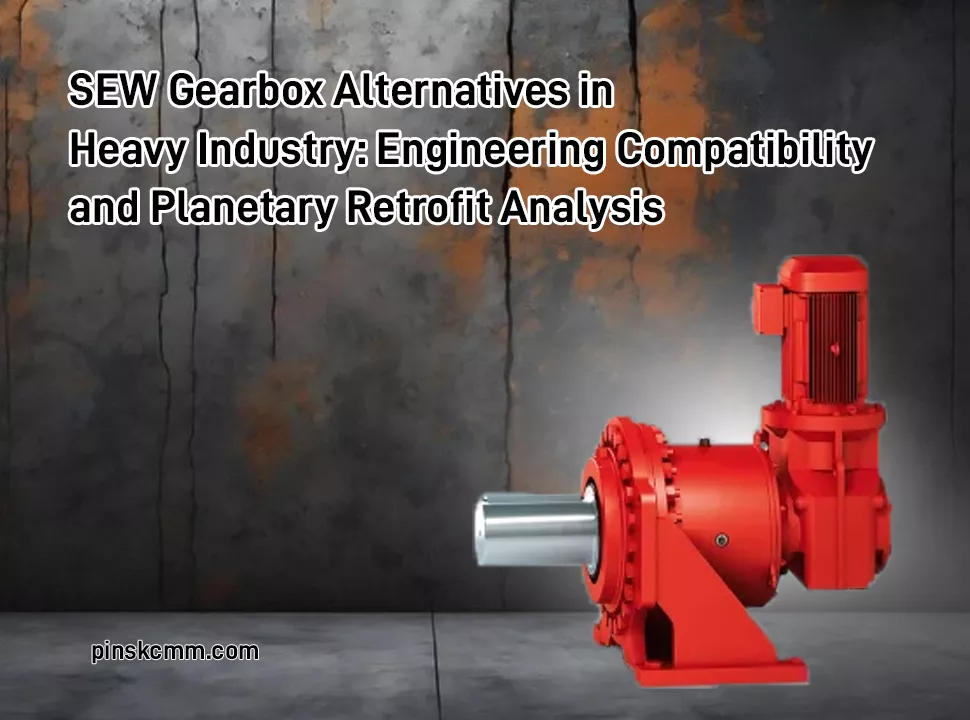
Industrial users across mining, cement, energy, and marine sectors increasingly evaluate alternatives to established SEW gearboxes as operating conditions intensify and maintenance windows tighten. Search behavior related to SEW gearboxes reflects a widespread need for high‑torque, reliable drive systems that can be integrated without extensive redesign of existing machinery.
As load cycles increase and continuous‑duty operation becomes standard, engineers focus less on brand continuity and more on torque density, dimensional compatibility, and long‑term mechanical stability when assessing replacement options.
Why SEW Gearbox Alternatives Are Being Evaluated
In many industrial installations, legacy helical or bevel‑helical SEW units were originally selected for moderate torque requirements. Over time, production scale‑up, process intensification, and extended operating hours have pushed these systems closer to their mechanical limits.
When failures occur—or when equipment reaches end‑of‑life—engineers seek replacement gearboxes capable of handling higher torque within the same installation envelope. This technical pressure naturally shifts attention toward planetary gearbox architectures due to their compact geometry and load‑sharing characteristics.
Buyer Search Behavior and Engineering Intent
Before selecting any replacement, engineers typically consult gearbox catalogues and technical documentation to establish baseline parameters. Torque ratings, reduction ratios, mounting arrangements, service factors, and thermal limits form the foundation of comparison.
SEW documentation has become a widely referenced benchmark, even among engineers evaluating non‑SEW solutions. Dimensional drawings, model codes, and configuration tables are regularly used to confirm whether alternative planetary drives can meet existing interface and performance requirements without introducing misalignment or overstress risks.
Planetary Gearbox Architecture as a Retrofit Solution
Planetary gear systems distribute transmitted load across multiple gear meshes simultaneously. This structural advantage reduces tooth stress, improves fatigue resistance, and enables significantly higher torque density compared to parallel‑shaft designs.
For retrofit scenarios, planetary gearboxes offer two critical advantages:
- High output torque within compact housings
- Coaxial input‑output alignment compatible with many existing installations
These attributes make planetary architectures particularly suitable where space constraints prevent upsizing conventional helical gearboxes.
Addressing High‑Torque Demand in Heavy Industry
Applications such as crushers, conveyors, mills, and marine handling equipment impose fluctuating loads and frequent shock conditions. In these environments, service factors alone are no longer sufficient protection against fatigue and thermal overload.
Planetary gearboxes are widely adopted in such use cases because their internal load distribution minimizes localized stress and stabilizes performance under variable operating conditions. This performance profile aligns well with industries experiencing rising power density requirements.
Dimensional Compatibility and Interface Constraints
One of the most critical challenges in replacing an installed gearbox is maintaining dimensional alignment. Engineers must verify output shaft geometry, flange patterns, bolt circles, shaft lengths, and coupling interfaces to avoid secondary mechanical issues.
Modern planetary gearbox platforms increasingly address this challenge through modular mounting options, configurable output shafts, and adaptable housings. Proper dimensional validation significantly reduces installation risk and prevents downstream reliability problems.
Engineering Factors Evaluated Before Replacement
Beyond torque and ratio matching, engineers assess a broader set of criteria when selecting an alternative gearbox.
Thermal capacity must support continuous operation without overheating. Lubrication systems are analyzed for compatibility with existing maintenance practices. Bearing arrangements and housing stiffness are evaluated to ensure stability under radial and axial loads.
These considerations often determine whether a retrofit will deliver long‑term reliability or simply transfer failure modes to a new component.
SEW P‑Series and X‑Series Replacement Context
SEW P‑Series gearboxes are commonly associated with high‑torque industrial applications such as bulk material handling and processing equipment. X‑Series units extend this range into ultra‑heavy‑duty environments where low‑speed torque dominates system design.
When these gearboxes approach end‑of‑life, engineers frequently assess planetary alternatives capable of overlapping torque ranges without increasing system footprint. Within the broader gearbox manufacturing ecosystem, solutions such as planetary platforms produced by manufacturers such as Seawide are referenced alongside other suppliers during this comparative evaluation process.
Lifecycle Cost and Operational Stability Considerations
Replacement decisions increasingly factor in lifecycle cost rather than initial acquisition alone. Higher torque density can reduce mechanical stress downstream, lower vibration levels, and decrease maintenance frequency.
Planetary gearboxes typically demonstrate favorable efficiency characteristics, which reduce energy losses and thermal stress over time. These attributes contribute to improved uptime and reduced total cost of ownership in demanding industrial environments.
Heavy‑Industry Use Cases and Retrofit Suitability
In mining and aggregates, planetary gearboxes commonly replace aging drives in conveyors, crushers, and bucket elevators where shock loads dominate.
In cement and materials processing, mixers and mills benefit from the stable torque delivery and thermal resilience of planetary systems.
Marine and offshore machinery relies on compact, high‑torque gearboxes capable of operating reliably in corrosive and vibration‑intensive environments.
Across these sectors, the priority remains consistent: maintaining mechanical compatibility while increasing performance margins.
As industrial systems continue to evolve toward higher power density and continuous operation, gearbox replacement has become a strategic engineering decision rather than a simple component swap. Evaluating SEW gearbox alternatives through the lens of torque capacity, dimensional compatibility, and structural efficiency allows engineers to modernize drive systems without compromising reliability or integration stability.
